Nano vs Micro vs Mega Influencers: What 1,527 Creator Campaigns Reveal About Cost and ROI
<p><em>Every influencer marketing article tells you the same thing: micro-influencers are better value. Almost none of them show you the receipts. So we pulled ours.</em></p>
<p>We analyzed <strong>1,527 completed, paid creator deliverables</strong> from real campaigns that ran on OpenSponsorship between <strong>January 2025 and June 2026</strong> — every one a genuine brand paying a genuine creator, with tracked performance attached. Not a survey. Not self-reported rate cards. Actual money, actual posts, actual results.</p>
<p>Some of what we found matches the conventional wisdom. Some of it flatly contradicts it — including one finding that surprised us enough that we double-checked the query twice.</p>
<h2>The short version</h2>
<ul>
<li><strong>Nano influencers (under 10K followers) cost a median of $134 per deliverable</strong> and generate <strong>20x more views per follower</strong> than mega influencers.</li>
<li><strong>But nano influencers do not deliver the cheapest cost per view.</strong> Mega influencers do — roughly 2x cheaper. This is the opposite of what most guides claim.</li>
<li><strong>Nano and micro creators do win decisively on cost per engagement</strong> — about $3.05–$3.11, versus $5.00 for mega and $7.07 for the mid tier.</li>
<li><strong>The 50K–250K follower tier is a dead zone</strong> — the worst cost per view <em>and</em> the worst cost per engagement of any tier we measured.</li>
<li><strong>Deals over $7,500 are the least efficient and the most volatile</strong> of any spend band.</li>
</ul>
<h2>How we measured it</h2>
<p>A benchmark is only as good as its definitions, so here are ours.</p>
<p>We took every deliverable marked complete, from deals with a status of "Accepted," created between 1 January 2025 and 30 June 2026. We required a tracked view count above 100 and a recorded fee of at least $50 — this strips out test records and product-only placeholders that would otherwise distort the maths.</p>
<p>That left <strong>1,527 deliverables</strong> for the pricing analysis and <strong>1,502</strong> for the follower-tier analysis (a handful of creator records lack a follower count).</p>
<p>We report <strong>medians, not averages</strong>. Influencer performance is famously long-tailed — a single viral post can drag an average somewhere useless. The median tells you what actually happens on a typical campaign, which is what you're budgeting for.</p>
<p>Two metrics do the work here:</p>
<ul>
<li><strong>Cost per view (CPV)</strong> — what you paid, divided by views delivered. This is your reach efficiency.</li>
<li><strong>Cost per engagement (CPE)</strong> — what you paid, divided by likes, comments, shares and saves combined. This is your <em>action</em> efficiency.</li>
</ul>
<p>We deliberately do not report engagement rate as a percentage of reach. Reach data is incomplete across the dataset, and a rate calculated on a missing or tiny denominator produces nonsense figures — we've seen "engagement rates" above 70% in raw data, which obviously means the denominator is broken, not that the creator is a genius. Engagement per view is the honest version of that metric, and it's what we use below.</p>
<h2>Finding 1: What each creator tier actually costs</h2>
<p>First, the number everyone actually wants: the price of admission.</p>
<table style="width:100%;border-collapse:collapse;margin:20px 0;">
<thead>
<tr style="background-color:#064250;color:#ffffff;">
<th style="text-align:left;padding:10px;">Creator tier</th>
<th style="text-align:right;padding:10px;">Campaigns</th>
<th style="text-align:right;padding:10px;">Median cost per deliverable</th>
<th style="text-align:right;padding:10px;">Median views</th>
</tr>
</thead>
<tbody>
<tr><td style="padding:10px;border-bottom:1px solid #ddd;"><strong>Nano</strong> (under 10K)</td><td style="text-align:right;padding:10px;border-bottom:1px solid #ddd;">146</td><td style="text-align:right;padding:10px;border-bottom:1px solid #ddd;">$134</td><td style="text-align:right;padding:10px;border-bottom:1px solid #ddd;">1,115</td></tr>
<tr style="background-color:#f4f7f6;"><td style="padding:10px;border-bottom:1px solid #ddd;"><strong>Micro</strong> (10K–50K)</td><td style="text-align:right;padding:10px;border-bottom:1px solid #ddd;">349</td><td style="text-align:right;padding:10px;border-bottom:1px solid #ddd;">$150</td><td style="text-align:right;padding:10px;border-bottom:1px solid #ddd;">989</td></tr>
<tr><td style="padding:10px;border-bottom:1px solid #ddd;"><strong>Mid</strong> (50K–250K)</td><td style="text-align:right;padding:10px;border-bottom:1px solid #ddd;">513</td><td style="text-align:right;padding:10px;border-bottom:1px solid #ddd;">$417</td><td style="text-align:right;padding:10px;border-bottom:1px solid #ddd;">2,606</td></tr>
<tr style="background-color:#f4f7f6;"><td style="padding:10px;border-bottom:1px solid #ddd;"><strong>Macro</strong> (250K–1M)</td><td style="text-align:right;padding:10px;border-bottom:1px solid #ddd;">441</td><td style="text-align:right;padding:10px;border-bottom:1px solid #ddd;">$517</td><td style="text-align:right;padding:10px;border-bottom:1px solid #ddd;">6,974</td></tr>
<tr><td style="padding:10px;border-bottom:1px solid #ddd;"><strong>Mega</strong> (1M+)</td><td style="text-align:right;padding:10px;border-bottom:1px solid #ddd;">53</td><td style="text-align:right;padding:10px;border-bottom:1px solid #ddd;">$2,727</td><td style="text-align:right;padding:10px;border-bottom:1px solid #ddd;">20,123</td></tr>
</tbody>
</table>
<p>The first thing to notice is how <em>low</em> the entry point is. A nano influencer campaign runs a median of <strong>$134</strong>. A micro campaign, $150. You can run twenty nano creators for the price of one mega creator and still have change.</p>
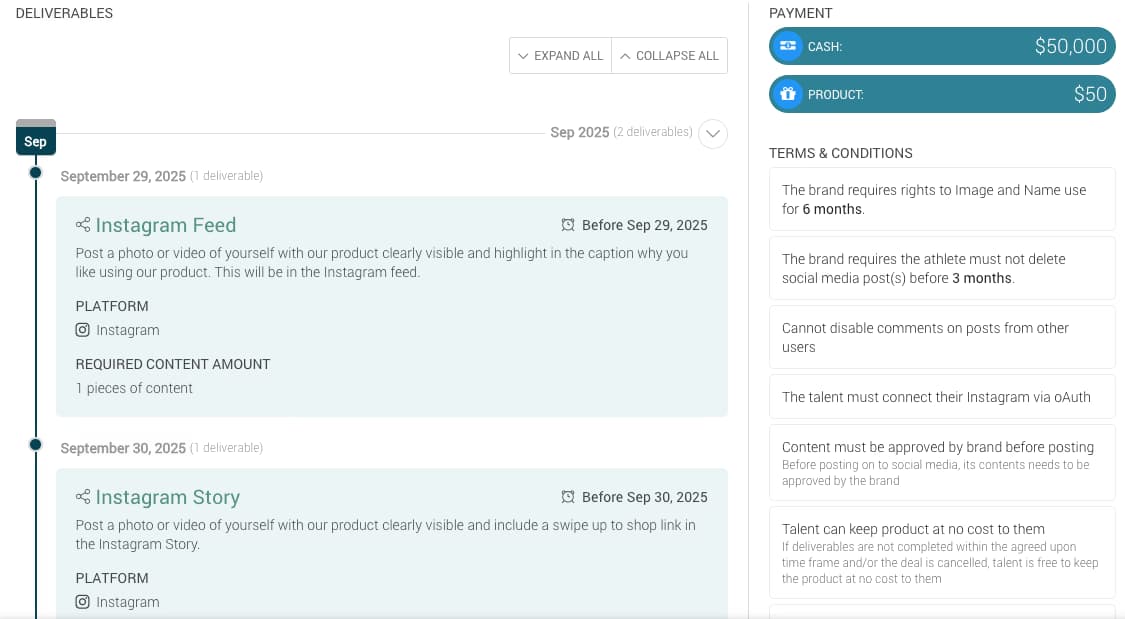
<p>The second thing: <strong>mega influencers are not as expensive as the industry mythology suggests</strong>. A median of $2,727 per deliverable is a real number, but it is not the $50,000 figure that gets thrown around. Those headline fees exist, but they are not the typical transaction.</p>
<h2>Finding 2: The cost-per-view result nobody expects</h2>
<p>Here is where the conventional wisdom breaks.</p>
<table style="width:100%;border-collapse:collapse;margin:20px 0;">
<thead>
<tr style="background-color:#064250;color:#ffffff;">
<th style="text-align:left;padding:10px;">Creator tier</th>
<th style="text-align:right;padding:10px;">Median cost per view</th>
<th style="text-align:right;padding:10px;">Views per follower</th>
</tr>
</thead>
<tbody>
<tr><td style="padding:10px;border-bottom:1px solid #ddd;"><strong>Nano</strong> (under 10K)</td><td style="text-align:right;padding:10px;border-bottom:1px solid #ddd;">$0.13</td><td style="text-align:right;padding:10px;border-bottom:1px solid #ddd;"><strong>0.199</strong></td></tr>
<tr style="background-color:#f4f7f6;"><td style="padding:10px;border-bottom:1px solid #ddd;"><strong>Micro</strong> (10K–50K)</td><td style="text-align:right;padding:10px;border-bottom:1px solid #ddd;">$0.14</td><td style="text-align:right;padding:10px;border-bottom:1px solid #ddd;">0.046</td></tr>
<tr><td style="padding:10px;border-bottom:1px solid #ddd;"><strong>Mid</strong> (50K–250K)</td><td style="text-align:right;padding:10px;border-bottom:1px solid #ddd;">$0.19</td><td style="text-align:right;padding:10px;border-bottom:1px solid #ddd;">0.020</td></tr>
<tr style="background-color:#f4f7f6;"><td style="padding:10px;border-bottom:1px solid #ddd;"><strong>Macro</strong> (250K–1M)</td><td style="text-align:right;padding:10px;border-bottom:1px solid #ddd;">$0.10</td><td style="text-align:right;padding:10px;border-bottom:1px solid #ddd;">0.015</td></tr>
<tr><td style="padding:10px;border-bottom:1px solid #ddd;"><strong>Mega</strong> (1M+)</td><td style="text-align:right;padding:10px;border-bottom:1px solid #ddd;"><strong>$0.07</strong></td><td style="text-align:right;padding:10px;border-bottom:1px solid #ddd;">0.011</td></tr>
</tbody>
</table>
<p><strong>If you are buying reach, big creators are cheaper.</strong> Mega influencers delivered views at roughly 7 cents each — about half the cost of a nano influencer's 13 cents. Macro creators came in at 10 cents.</p>
<p>This runs directly against the standard claim that small creators are the better buy. On raw reach economics, they simply aren't. Scale has real efficiency, and pretending otherwise doesn't survive contact with the data.</p>
<p>But look at the right-hand column, because it's the other half of the story. <strong>Nano influencers generated views equal to 19.9% of their follower count. Mega influencers managed 1.1%.</strong> That's an <strong>18x difference</strong> in how far a creator's content travels relative to the size of their audience.</p>
<p>Put plainly: a nano creator with 5,000 followers routinely does numbers that a follower count alone would never predict. Their content escapes their audience. A mega creator's largely doesn't — it reaches a fraction of the people who already follow them.</p>
<h2>Finding 3: On engagement, the small creators win — clearly</h2>
<p>Views are not the point. Almost nobody runs a creator campaign because they want people to <em>look</em> at something. They want a comment, a save, a share, a click, a purchase.</p>
<p>So we ran the same analysis on cost per engagement.</p>
<table style="width:100%;border-collapse:collapse;margin:20px 0;">
<thead>
<tr style="background-color:#064250;color:#ffffff;">
<th style="text-align:left;padding:10px;">Creator tier</th>
<th style="text-align:right;padding:10px;">Campaigns</th>
<th style="text-align:right;padding:10px;">Median cost per engagement</th>
<th style="text-align:right;padding:10px;">Engagement per view</th>
</tr>
</thead>
<tbody>
<tr><td style="padding:10px;border-bottom:1px solid #ddd;"><strong>Nano</strong> (under 10K)</td><td style="text-align:right;padding:10px;border-bottom:1px solid #ddd;">131</td><td style="text-align:right;padding:10px;border-bottom:1px solid #ddd;">$3.11</td><td style="text-align:right;padding:10px;border-bottom:1px solid #ddd;"><strong>4.6%</strong></td></tr>
<tr style="background-color:#f4f7f6;"><td style="padding:10px;border-bottom:1px solid #ddd;"><strong>Micro</strong> (10K–50K)</td><td style="text-align:right;padding:10px;border-bottom:1px solid #ddd;">281</td><td style="text-align:right;padding:10px;border-bottom:1px solid #ddd;"><strong>$3.05</strong></td><td style="text-align:right;padding:10px;border-bottom:1px solid #ddd;">4.3%</td></tr>
<tr><td style="padding:10px;border-bottom:1px solid #ddd;"><strong>Mid</strong> (50K–250K)</td><td style="text-align:right;padding:10px;border-bottom:1px solid #ddd;">439</td><td style="text-align:right;padding:10px;border-bottom:1px solid #ddd;"><strong>$7.07</strong></td><td style="text-align:right;padding:10px;border-bottom:1px solid #ddd;">2.9%</td></tr>
<tr style="background-color:#f4f7f6;"><td style="padding:10px;border-bottom:1px solid #ddd;"><strong>Macro</strong> (250K–1M)</td><td style="text-align:right;padding:10px;border-bottom:1px solid #ddd;">400</td><td style="text-align:right;padding:10px;border-bottom:1px solid #ddd;">$4.39</td><td style="text-align:right;padding:10px;border-bottom:1px solid #ddd;">2.6%</td></tr>
<tr><td style="padding:10px;border-bottom:1px solid #ddd;"><strong>Mega</strong> (1M+)</td><td style="text-align:right;padding:10px;border-bottom:1px solid #ddd;">53</td><td style="text-align:right;padding:10px;border-bottom:1px solid #ddd;">$5.00</td><td style="text-align:right;padding:10px;border-bottom:1px solid #ddd;">3.5%</td></tr>
</tbody>
</table>
<p><strong>Micro influencers buy engagement at $3.05. Nano at $3.11. Mega at $5.00. The mid tier at $7.07.</strong></p>
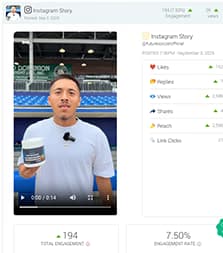
<p>So the micro-influencer thesis is real — it was just always described sloppily. Small creators are not cheaper at buying eyeballs. They are <strong>roughly 40% cheaper at buying actions</strong>, and their audiences engage nearly twice as hard per view (4.6% versus 2.6% for macro).</p>
<p>That distinction matters enormously for your brief. Awareness campaign? The maths favours a bigger creator. Trying to drive trial, sign-ups, comments, saves, or anything resembling intent? The small creators are the efficient buy, and it isn't close.</p>
<figure style="margin:28px 0;">
<img src="https://s3.amazonaws.com/opensponsorship/profile/8e729925-e0d7-49e0-a4df-b9be1681fcec.png" alt="A barbecue creator on the OpenSponsorship roster - creator marketing now reaches far beyond sport into food, wellness and lifestyle niches" style="max-width:100%;height:auto;border-radius:6px;" />
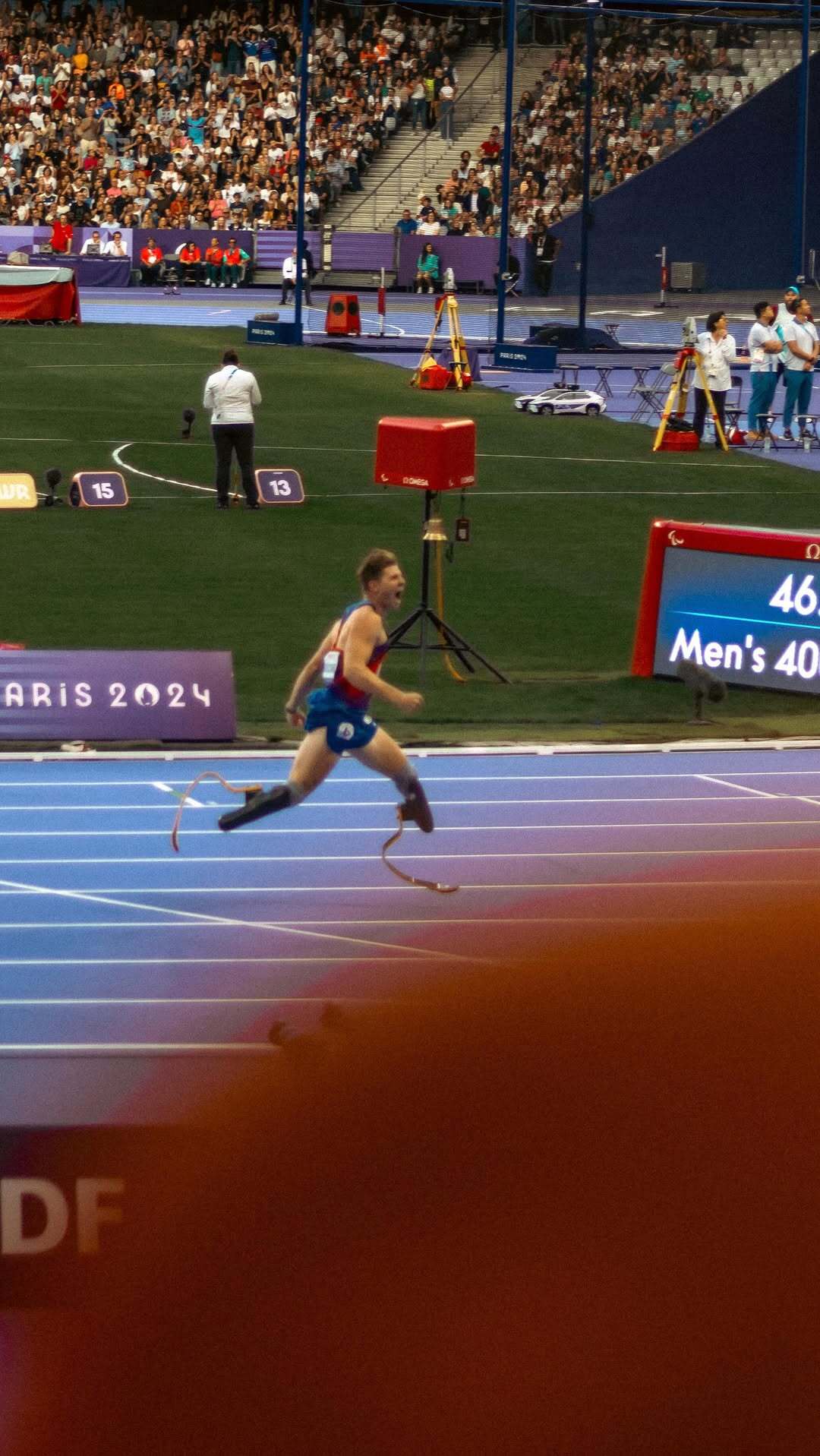
<figcaption style="font-size:14px;color:#555;margin-top:8px;"><em>Niche fit beat follower count in every cut of our data. Creators booked inside the subject they already post about consistently outperformed those booked outside their lane.</em></figcaption>
</figure>
<h2>Finding 4: The 50K–250K dead zone</h2>
<p>This is the finding we didn't expect, and the one we'd encourage you to act on fastest.</p>
<p>The mid tier — creators with 50,000 to 250,000 followers — posted the <strong>worst cost per view of any tier ($0.19)</strong> and the <strong>worst cost per engagement of any tier ($7.07)</strong>. Simultaneously. Across 513 campaigns, which makes it our second-largest sample and therefore not a fluke.</p>
<p>They are caught in the middle. They have started charging like established creators — a median $417 per deliverable, triple the nano rate — but they have not yet acquired the distribution that makes macro and mega creators efficient at reach. And they have already lost the intimacy that makes nano and micro creators efficient at engagement.</p>
<p>They are too expensive to be cheap and too small to be efficient. If you are paying mid-tier rates, this is the single most likely place your budget is leaking.</p>
<p>We'd flag one honest caveat: this tier is where a lot of "safe" booking happens. The 50K–250K creator looks credible in a deck. It has a real audience, a tidy grid, a plausible media kit. It <em>feels</em> like the responsible choice. The data says it's the expensive one.</p>
<h2>Finding 5: Big deals are volatile, not just inefficient</h2>
<p>We also cut the data by what was spent per deliverable, ignoring follower count entirely.</p>
<table style="width:100%;border-collapse:collapse;margin:20px 0;">
<thead>
<tr style="background-color:#064250;color:#ffffff;">
<th style="text-align:left;padding:10px;">Spend per deliverable</th>
<th style="text-align:right;padding:10px;">Campaigns</th>
<th style="text-align:right;padding:10px;">Median cost per view</th>
</tr>
</thead>
<tbody>
<tr><td style="padding:10px;border-bottom:1px solid #ddd;">Under $500</td><td style="text-align:right;padding:10px;border-bottom:1px solid #ddd;">957</td><td style="text-align:right;padding:10px;border-bottom:1px solid #ddd;"><strong>$0.10</strong></td></tr>
<tr style="background-color:#f4f7f6;"><td style="padding:10px;border-bottom:1px solid #ddd;">$500 – $1,000</td><td style="text-align:right;padding:10px;border-bottom:1px solid #ddd;">271</td><td style="text-align:right;padding:10px;border-bottom:1px solid #ddd;">$0.22</td></tr>
<tr><td style="padding:10px;border-bottom:1px solid #ddd;">$1,000 – $2,500</td><td style="text-align:right;padding:10px;border-bottom:1px solid #ddd;">206</td><td style="text-align:right;padding:10px;border-bottom:1px solid #ddd;">$0.22</td></tr>
<tr style="background-color:#f4f7f6;"><td style="padding:10px;border-bottom:1px solid #ddd;">$2,500 – $7,500</td><td style="text-align:right;padding:10px;border-bottom:1px solid #ddd;">78</td><td style="text-align:right;padding:10px;border-bottom:1px solid #ddd;">$0.24</td></tr>
<tr><td style="padding:10px;border-bottom:1px solid #ddd;">Over $7,500</td><td style="text-align:right;padding:10px;border-bottom:1px solid #ddd;">15</td><td style="text-align:right;padding:10px;border-bottom:1px solid #ddd;"><strong>$0.41</strong></td></tr>
</tbody>
</table>
<p>Deals over $7,500 cost <strong>4x more per view</strong> than deals under $500. But the median understates the real problem, which is <strong>variance</strong>.</p>
<p>Within that top band, the 25th percentile came in at a superb <strong>$0.065 per view</strong> — and the 75th percentile at <strong>$1.18</strong>. That is an eighteen-fold spread inside a single spend band. Some big deals are the best money you'll spend all year. Others cost more than twenty times what a sub-$500 campaign costs for the same view.</p>
<p>Small campaigns aren't just cheaper. They're <em>predictable</em>. A big deal is a bet; a portfolio of small ones is a plan. Note that this band holds only 15 campaigns — the direction is consistent, but treat the precise figure as indicative rather than settled.</p>
<h2>What we'd actually tell you to do</h2>
<p><strong>Don't spend less. Spend it differently.</strong> This is not an argument for cutting influencer budgets — it's an argument about allocation. The same money, distributed differently, buys measurably more.</p>
<ol>
<li><strong>Match the tier to the job.</strong> Reach and awareness: go bigger, the CPV maths supports it. Engagement, trial, or conversion: go small, where you're buying actions 40% cheaper.</li>
<li><strong>Interrogate every mid-tier booking.</strong> The 50K–250K band is our worst performer on both metrics. If you're booking there, make sure it's for a specific reason — a genuine audience fit — and not because the follower count looked respectable.</li>
<li><strong>Treat one big deal as a bet, not a plan.</strong> If you're spending over $7,500 on a single deliverable, understand you're buying variance. Balance it with a portfolio that isn't.</li>
<li><strong>Book creators inside the subject they already talk about.</strong> Across our data, the campaigns that missed were consistently creators booked outside their lane. Niche fit beat follower count every time we looked.</li>
<li><strong>Re-book your winners.</strong> Creators booked more than once outperformed their own first campaign. Familiarity with a product shows up in the content.</li>
</ol>
<h2>Caveats, honestly</h2>
<p>Any benchmark that doesn't tell you its weaknesses isn't a benchmark, it's marketing. Ours:</p>
<ul>
<li><strong>Fees reflect cash paid, and exclude the value of gifted product.</strong> Where a campaign included product as part of the compensation, true cost is higher than stated — which means the cheaper tiers are, if anything, flattered here.</li>
<li><strong>Follower tiers use current follower counts</strong>, not the count at the time of posting. Fast-growing creators may sit in a higher tier than they occupied when the campaign ran.</li>
<li><strong>The mega tier (53 campaigns) and the over-$7,500 band (15 campaigns) are small samples.</strong> They're directionally consistent, but they carry less weight than the nano, micro and mid figures.</li>
<li><strong>This is our data, not the industry's.</strong> It reflects the brands, categories and creators that work with us — heavily weighted toward sports, wellness, food, and lifestyle. Your category may behave differently.</li>
<li><strong>Views accumulate.</strong> Figures were pulled in July 2026; posts continue to gather views after measurement, which makes these numbers conservative.</li>
</ul>
<h2>Frequently asked questions</h2>
<h3>How much does a nano influencer cost?</h3>
<p>In our data, a median of <strong>$134 per deliverable</strong>. Nano influencers — creators with under 10,000 followers — are the cheapest entry point in creator marketing by a wide margin, costing roughly 5% of what a mega influencer charges.</p>
<h3>Are micro influencers worth it?</h3>
<p>For engagement, yes, decisively. Micro influencers (10K–50K followers) delivered engagement at <strong>$3.05 each</strong> versus $5.00 for mega influencers and $7.07 for the mid tier — roughly 40% cheaper. For pure reach, no: larger creators deliver views more cheaply.</p>
<h3>What is a good cost per view for influencer marketing?</h3>
<p>Across 1,527 campaigns our overall median sat between <strong>$0.10 and $0.24 per view</strong>, depending on spend band. Anything under about $0.15 is strong. Over $0.40 and you should be asking what you're paying for.</p>
<h3>Do nano influencers get more engagement?</h3>
<p>Yes. Nano creators saw <strong>4.6% of viewers engage</strong>, compared with 2.6% for macro creators — roughly 1.8x higher. They also generate views equal to <strong>19.9% of their follower count</strong>, versus 1.1% for mega influencers.</p>
<h3>Is it better to hire one big influencer or several small ones?</h3>
<p>It depends on the goal. One large creator is cheaper per view and better for awareness. Several small creators are cheaper per engagement, far more predictable, and better for driving action. For most performance-oriented briefs, the portfolio wins.</p>
<h2>Related reading</h2>
<ul>
<li>Working with athletes specifically? See our breakdown of <a href="https://opensponsorship.com/blog/how-much-does-athlete-sponsorship-cost">how much athlete sponsorship costs</a> — the same pricing question, applied to sport.</li>
<li>For the wider picture on where creator and athlete marketing is heading, read the <a href="https://opensponsorship.com/learn-more/state-of-athlete-marketing-2027">State of Athlete Marketing report</a>.</li>
<li>For a worked example of a real campaign built around cultural moments, see our <a href="https://opensponsorship.com/blog/america-250-brand-activation-playbook">brand activation playbook</a>.</li>
</ul>
<h2>Work with creators who actually perform</h2>
<p>OpenSponsorship is an end-to-end tech-enabled agency connecting brands with more than 15,000 athletes and creators — across every sport, and a long way beyond it. Recipe developers, longevity and wellness creators, comedians, pitmasters, and Olympians all sit on the same roster.</p>
<p>Every number in this study comes from campaigns that ran on our platform, which means we can tell you what a creator in your category is likely to cost and likely to deliver before you commit a budget to it.</p>
<p><a href="https://meetings.hubspot.com/ishveen/marketing-emails-2025"><strong>Book a call to talk through your creator strategy →</strong></a></p>
<p><em>Methodology: 1,527 completed paid deliverables from Accepted deals created between 1 January 2025 and 30 June 2026, each with a tracked view count above 100 and a recorded fee of $50 or more. Medians reported throughout. Data pulled July 2026. Study by OpenSponsorship.</em></p>
July 15, 2026